Copper and aluminum are the two most widely used conductor materials in the wire and cable industry. Understanding how to distinguish them and knowing their respective advantages can help manufacturers choose the right production process and equipment for different applications.
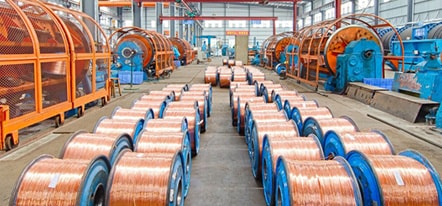
The easiest way to identify copper and aluminum conductors is by their appearance. Copper has a distinctive reddish-brown color with a metallic shine, while aluminum features a bright silver-white surface. Copper is also noticeably heavier than aluminum of the same size because of its higher density. In addition, copper is softer and more flexible, making it easier to bend repeatedly without breaking. Aluminum, although lighter, is generally stiffer and requires appropriate handling during processing.
In terms of electrical performance, copper offers higher electrical conductivity, lower resistance, and better heat dissipation. These characteristics make copper the preferred choice for high-performance power cables, building wires, industrial cables, and data communication cables where reliability and efficiency are essential.
Aluminum, on the other hand, has the advantage of being lightweight and more cost-effective. Although its conductivity is lower than copper, increasing the conductor cross-sectional area can compensate for this difference in many applications. Aluminum conductors are widely used in overhead transmission lines, utility power distribution, renewable energy projects, and other installations where reducing weight and controlling material costs are important.
From a manufacturing perspective, copper and aluminum require different production parameters throughout the wire drawing, annealing, stranding, extrusion, and take-up processes. Equipment designed with adjustable tension control, optimized dies, and stable process automation ensures consistent product quality regardless of conductor material.
As a professional wire and cable equipment supplier, we provide complete production line solutions for both copper and aluminum cable manufacturing. Our equipment is engineered to deliver high efficiency, reliable performance, and excellent production consistency, helping cable manufacturers improve productivity while meeting diverse market demands.
Whether your project focuses on premium copper cables or cost-efficient aluminum cables, selecting the appropriate equipment is the key to achieving stable production, reducing operational costs, and ensuring long-term product quality.



 Tel: +86 17818847636


No.55, Boyong Road, Humen Town, Dongguan City, Guangdong, China
By continuing to use the site you agree to our privacy policy Terms and Conditions.




 EN
EN